
POR YURI FIRMEZA. Texto escrito na ocasião da abertura da exposição “Barulho de Dentro”, de Juliana Siebra, em 2019 (english below)
A menina, que não conhecia o mar, se deparou com a imagem de uma cóclea num livro ilustrado de biologia. Por escolha própria, decidiu não aprender a ler. E por não saber ler, apreendia o mundo e suas imagens sem legendas. A cóclea era uma linha, uma espiral equiangular sem nome próprio. Quando preciso, nomeava ao seu modo: um traço mais longo, um pontilhado, uma macha, uma profundeza, uma sombra. A amiga, sabendo de seu encanto pela cóclea, deu-lhe, anos depois, uma grande concha que trouxera da praia. Explicou-a que a concha guardava todo o barulho do mar. A menina nunca mais largou a concha-cóclea. Aproximava o barulho do mar, encerrado naquela espiral, aos ouvidos de desconhecidos. Obsessiva e solitariamente, desenhava o barulho contido no barroquismo daquelas curvas. Anos depois o encontro com o mar foi incontornável. Aquela imensidão, o barulho de dentro.
Juliana Siebra, ampara a cóclea na mão direita e a concha na mão esquerda, estática em frete ao mar revolto, leva os objetos aos ouvidos. De súbito, ruídos do corpo e ruídos do mar tornam-se indistinguíveis. O mar é mundo.
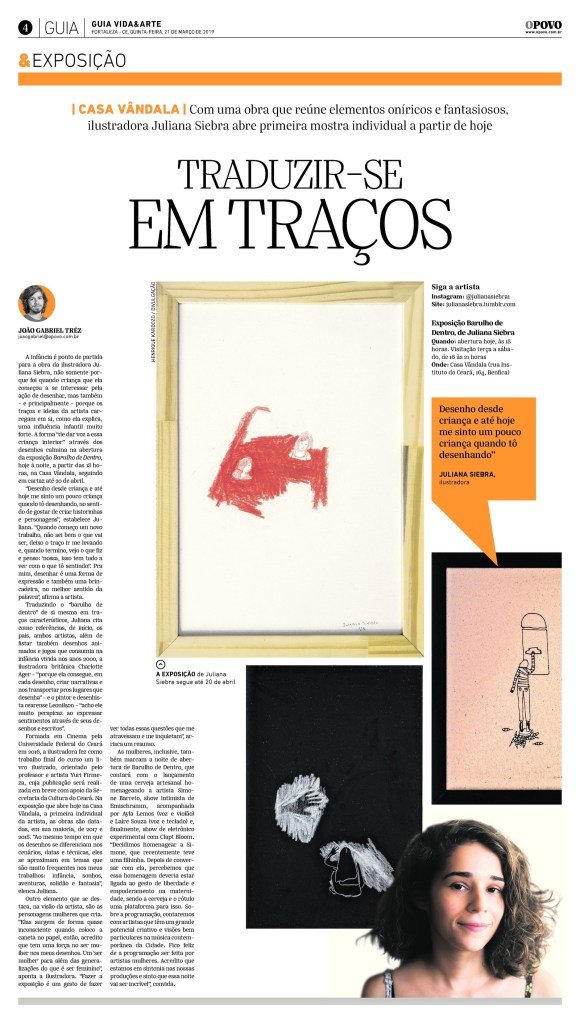
Numa solidão povoada por estas imensidões, desenha o que o gesto do desenhar a convoca. Manchas sobre o fundo preto, corpos femininos, fragmentos e detalhes, instantes narrativos, linhas soltas e em movimento.
Há uma infância, como toda sua alegria política, que nos faz lembrar, por exemplo, a poesia de Manoel de Barros. Os títulos aqui assumem também um aspecto importante do trabalho. Por vezes mais literais, por vezes tautológicos, mas sempre com uma dimensão poética que confere ao desenho uma leitura possível sem defini-la como a leitura exata. E essa inexatidão é o desajuste das formas que os traços da Juliana nos faz pensar.
O desenho que dá nome à exposição nos mostra um corpo atravessado pelas forças do mundo. Contorcido, com uma das mãos sobre a boca, a expressão nos sugere um grito que preenche o suposto vazio branco do papel. O grito – ou o espasmo disforme e incontido – transborda as linhas vermelhas e virtualmente ecoa para além das bordas do papel. O barulho que vem de dentro, como uma força que pede passagem, não pode ser silenciado. E aí reside o conjunto de trabalhos apresentados por Siebra nesta exposição, o que vem de dentro não é uma suposta expressão da subjetividade da artista em sua interioridade e redoma. Ao contrário, o barulho de dentro, volátil e ensurdecedor, não opõe o dentro ao fora. É a concha-cóclea do imensurável ofertado aos ouvidos insuspeitos. É todo um mundo que pede passagem. É aquela imensidão, o barulho de dentro.
BY YURI FIRMEZA. Text written in the occasion of Juliana Siebra’s solo exhibition “the Noise Within”, 2019
The girl, who did not know the sea, came across the image of a cochlea in an
illustrated biology book. By her own choice, she decided not to learn how to
read. And because she couldn’t read, she captured the world and its images
without captions. The cochlea was a line, an equiangular spiral with no proper
name. When needed, she would name it in her own way: a longer stroke, a dotted
line, a blemish, a depth, a shadow. Her friend, aware of her fondness for the
cochlea, gave her, years later, a large shell she had brought from the beach. She
explained to her that the shell contained all the noise of the sea. The girl did not
let go of the cochlea-shell ever since. She would bring the sound of the sea,
enclosed in that spiral, up to the ears of strangers. Obsessive and solitarily, she
drew the noise contained in the baroqueness of those curves. Years later, the
encounter with the sea was unavoidable. That immensity, the noise within.
Juliana Siebra holds the cochlea in her right hand and the shell in her left hand,
static in front of the rough sea, she brings the objects to her ears. Suddenly,
bodily noises and sea noises become indistinguishable. The sea is the world.
In a solitude populated by these immensities, she draws what the gesture of
drawing prompts her to. Stains on the black background, female bodies,
fragments and details, narrative moments, loose lines in motion.
There is a childhood, like all its political joy, that reminds us, for instance, of
Manoel de Barros’ poetry. The titles here also take on an important aspect of the
work. At times more literal, sometimes tautological, but always with a poetic
dimension that gives the drawing a possible reading without defining it as the
exact reading. And this inexactness is the mismatch of forms that Juliana’s
strokes make us think.
The drawing that gives the exhibition its name shows us a body traversed by the
forces of the world. Contorted, with one hand over the mouth, the expression
suggests a scream that fills the supposed white emptiness of the paper. The
scream – or the formless and unrestrained spasm – spills over the red lines and
virtually echoes beyond the edges of the paper. The noise that comes from
within, like a force that demands to be let through, cannot be silenced. And
therein lies the set of works presented by Siebra in this exhibition, what comes
from within is not a supposed expression of the artist’s subjectivity in her
interiority and dome. On the contrary, the noise within, volatile and deafening,
does not set the inner against the outer. It is the cochlea-shell of the
immeasurable, offered to unsuspecting ears. It’s a whole world that demands to
be let through. It’s that immensity, the noise within.
 Juliana Siebra